STORY BY MATT SMITH • ERIN WARD • DOUG BOYD banner

CHANGING CLASSES

From kindergarten to high school, ECU teachers are making school work during
COVID-19.

Online classes. Face-to-face classes. Virtual Mondays. Zoom, Seesaw and Bitmoji.

Twelve months ago, few thought about these concepts or technologies in public schools. Not anymore.

“I never thought I’d have another first year of teaching, but this is it,” said Beth Mahony ’03, a fifth-grade teacher at Colin Powell Elementary School in Centreville, Virginia. “I have to learn new skills with new technology and then somehow teach it to my kids as well, even when I’m green as a gourd myself.”

Mahony and three other teacher alumni sent East a week’s worth of thoughts and experiences from the 2020-2021 school year. Read about them on the next several pages.

Alex Bryant

Alex Bryant ’17 teaches ninth-grade world history at Purnell Swett High School in Pembroke.

Mon Aug 31

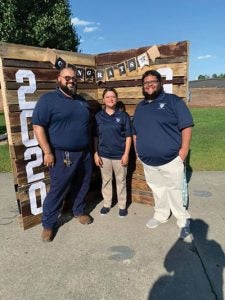
Bryant (right) and Purnell Swett High School teaching team members greet students at Swett’s drive-through graduation last spring.

9:31 a.m.: I got into work a bit before 8 a.m. Two of my assistant principals were at the door taking our temperatures and asking us COVID screening questions. Today we have all three world history classes together for lecture. I am teaching on Mesopotamia and ancient Egypt, but before I can make it to Egypt, the internet goes out. It has not returned. We had to tell kids using our phones to work on their assignments that are due this week.

Noon: My world history team and I prepare assignments for the following week. Today we spent the time calling students who did not do much work last week. We usually do not have this much of a problem with students not working, but online work is a different beast. This can be stressful, so to cool off some of my team and I walk a lap around the school with our masks on.

3 p.m.: The rest of the day the internet worked pretty well. Third and fourth period had some wonderful questions in the chat box. Although it was a pretty good discussion, I cannot help but to think how much better it would have been in person. We desperately miss actually being in front of our kids. We feel like we cannot reach them how we normally do. It is honestly hard for us not being with them. There have been many of us literally in tears because this is not how school should be.

Tue SEPT 1

9:40 a.m.: Today is the first day we are teaching from home. As a core class, I teach from home on Tuesdays, Thursdays and Fridays. I may have stayed in bed a little longer than usual this morning. As soon as I got up, I had assignments to grade and emails and texts to answer. First period went smoothly. We have a steady number of kids that show up to these online meetings. Rarely do we get them all online. They are still getting used to Canvas. We are having to explain numerous times how to submit work, access notes and get on their live meetings. The rest of the time we spend reviewing yesterday’s lecture.

1:35 p.m.: Third period just finished. It is pretty cool being able to be comfortable at home while working. This definitely has its perks. However, I would still rather be in the classroom. One thing that really helps in this virtual setting is kids having a badge that shows me something they care about. I have one student that had a Boston Celtics player on his badge. I do not like the Celtics, so I was able to joke with them and start a conversation about sports. Other students have anime characters, musical artists and other icons that show me who they are. I still cannot get to know them as much as I like, but the badges certainly help.

3:15 p.m.: The first day of working at home was rather successful. I started getting a headache, but I was able to light my eucalyptus candle to help with stress relief. I certainly could not do that at work. Although I was able to be more relaxed at home, I really missed being with my co-workers. I love my job so much because of my team. I have the best team you could ask for, so working without them just is not the same.

wed SEPT 2

Noon: I have said it once and I’ll say it again, I have the best team. Having no kids on campus means my co-worker Mrs. Courtney can bring us food! She made us a low-country boil and it was wonderful. During this lunch/planning period I had to call six students who have not been on our online platform at all. I had two explain they are in the process of getting Wi-Fi. Another student cannot get their laptop to access the information. One parent explained they cannot get their child to do any work. The last two I could not get in touch with.

thu SEPT 3

8:30 a.m.: Since we are working from home and I have a long weekend, I decided to go visit a friend for a few days. This friend has been working from home since March and is one of the people in my small group of friends and families that I have seen throughout COVID. I know he has done what he must to remain safe and social distance, so I felt it was not a problem to visit. It will be interesting working from his one-bedroom apartment. There is only so much space and we both will be online talking to people. Hopefully it goes well.

fri SEPT 4

7 p.m.: On Fridays we do not meet online with our kids. Today is the day set aside for them to take their tests. Although we are not formally meeting on Google Meet or Zoom, they can still reach me through Canvas, email and my Google number. I am still on the clock from 8 a.m. to 3 p.m., so I am here if they need me. Although we have designated hours, we are available pretty much all day and most of the night. We understand some of our kids can only do work later in the day, so we need to be there to help them. Teachers are dedicated people in normal circumstances. We certainly do not get paid enough for what we do. Our hours are now longer. We have to be available for our students who cannot work during traditional school hours. As I finish this entry, I will turn my attention to grading and answering emails.

Kristen Flynn

Kristen Flynn ’18 is a kindergarten teacher at H.B. Sugg Elementary School in Farmville.

Mon sept 14

7:30 a.m.: Out of the control of our school, devices were very delayed for kindergarten students, so all of the kindergarten students just got their devices last week. I have had to plan digital lessons that students could somehow do at home, without a device. Today is the first day that my students will use the learning platform Seesaw to complete their virtual learning. I am posting their assignments in a template that I am hoping is very easy for them to navigate. I worked for countless hours on this template and on a Bitmoji classroom full of extra resources for my students. This morning, I am already responding to lots of parent messages about technology issues, getting into Seesaw, things not working, etc. I am also making video tutorials to post on my class Facebook page, to hopefully help families.

12:30 p.m.: I am just getting out of my second meeting. I still haven’t had lunch or gone to the bathroom today. Parents are still having technology issues and questions about how to navigate Seesaw and the assignments. Parents are frustrated and I understand why. I just wish they knew how hard I was working on the other side of the screen.

3 p.m.: Despite all of the technology issues and questions that parents had today, I am impressed with how many of my students did their work on Seesaw.

5 p.m.: I just shut my computer down for the day. Our day does not end when the students leave the building at 1:30 p.m.

tue sept 15

11 a.m.: I have been assessing students on Zoom this morning. It makes my heart so happy to hear and see how excited they are to be talking to me. It amazes me how pure children are; they have only met me one time (at our open house) and still they are bursting with excitement on these Zoom calls and making sure to tell me that they love me. Even on the tough days, I remember the little faces that are behind those screens that need me.

4 p.m.: Once again, I am happy with the amount of my students that got on Seesaw and turned things in today. I spent a good portion of this afternoon reaching out to parents of students that have not turned anything in yet. A huge part of my job is making sure that I am fully communicating with parents, being transparent with them and giving them grace.

7 p.m.: I am home but still working. I am getting progress reports set up for each child and getting them filled out and ready to send to parents tomorrow.

wed sept 16

11 a.m.: Planning ahead is hard to do but I am trying to do some of that this morning. I have a student who has a broken device, so I had to figure out what to do about that. I also got a new student this morning, so I am reaching out to them and getting information from them so that I can get her a device and set up on Seesaw.

3:30 p.m.: I am finishing up for the day. I have been checking assignments on Seesaw and trying to check in with parents. My students are doing well with Seesaw. This teacher’s heart is proud!

wed sept 17

7:30 a.m.: The internet was being slow and nothing would post to Seesaw, so I had to post on our class Facebook page.

wed sept 18

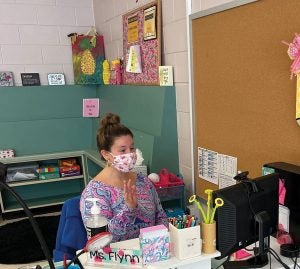
Kristen Flynn teaches from her classroom.

7:30 a.m.: I woke up to over 20 messages from parents, so I took some time responding to them.

10:45 a.m.: I had a hard time coming up with something fun to do with my virtual students as a rewards system. Some type of rewards system is so important at this age but especially virtually, because they have to be motivated somehow. I decided to do virtual marble jars. Each student has their own marble jar, and each day if a student does their check-in and all of their work, they get a marble in their jar. Every other Friday, I put all of the students’ names who have 10 marbles in their jar into a name-choosing app and choose two students. Those two students get to choose from a choice board of virtual rewards (for example, lunch with your teacher on Zoom, wear a hat to Zoom, virtual field trip just for you, read aloud from your teacher). This morning, I am working on updating all of the marble jars. I am hoping this will keep my students motivated and excited to do the work!

Beth Mahony

Beth Mahony ’03 is a fifth-grade teacher at Colin Powell Elementary School in Centreville, Va.

Mon sept 14

9 a.m.: Today is our second Monday, and I still don’t really know what I’m supposed to do with the time. Initially, Monday was supposed to be planning, but half the day is now to connect with kids and meet with small groups (mostly interventions). If I were in school with data, I would know which kids need what from me. I can do this, but I wish things were more clear. There’s still so much unknown.

11:05 a.m.: I’ve met with all my kids today and am done. Now what? I’ve turned them loose after explaining what they should do with their time on Mondays AGAIN. I hate second-guessing myself. I never do when I’m in the building. Now I’m wondering, would I be in trouble for letting them go early? And how am I supposed to tell kids which specialists wanted to see them? How is that also my job? AND, I have never heard this staff sound like we did today. One teacher sounded like she was about to cry. Others are super frustrated about the amount of time we’re working outside of contract hours and how much is falling on the classroom teachers. It felt like we were turning on each other.

4:12 p.m.: HOLY COW! We just had a staff meeting of the sort that has never happened at my school, and I’ve been here for eight years now. There is another plan for Mondays to streamline kids getting to see a specialist, if they’re invited, and it is so confusing! I usually have no problem understanding the how and why we do things, but this doesn’t make sense.

tue sept 15

1:10 p.m.: WOW! I feel like I was really a teacher just now. I am taking time each day to just read to my kids. It is the best feeling because I know what I’m doing, and I’m good at it. And my kids are asking and answering questions and totally into the story!

3:38 p.m.: First time I really felt odd about being “in” people’s homes. A mom jumped in on a conversation I was having with her son earlier. I get it and I appreciate her support, but I really just need her son to answer some questions if I’m going to help him. It was awkward. Definitely tired and glad today is over. Now, I’ll get some planning done.

tue sept 16

9:12 a.m.: I’ve just put a message in my classroom chat for kids to have their paper/pencil/whiteboards ready to do some math with me. I already have 26 out of 28 logged on. I am feeling pretty good about today. They’re getting into the routine.

10:45 a.m.: So I tried something brand new today, and it didn’t work. I’m sure there’s some button I didn’t click or something, but it is so frustrating. And with the limited time I have for our science lessons, spending part of that time walking them through the electronic piece of it to not have it work is a colossal waste of time. I’m falling behind in my science lessons, and I love science. I’ll figure it out, but it’ll just take more time in my evening.

10:58 p.m.: I didn’t realize how late it was, so I need to stop planning, looking at student work and replying to emails!!!

wed sept 17

4 a.m.: I’ve been awake for hours now. I did fall asleep, too late, but woke up sometime after 1 a.m. Falling asleep has never been a problem because school wears me out. It still does, but it is a different kind of tired this year. Anyway, I couldn’t go back to sleep so I decided I should just give up and start working. My mind is constantly on school anyway, and if I get some work done, maybe I’ll feel better.

9:10 a.m.: Class is about to start, and I’m feeling so tired now. OF COURSE! I’ve not had an all-nighter since college. Today should be interesting, and I’m praying for patience.

3:25 p.m.: I’ve gotten through it and didn’t snap at anyone. My dog hung out with me the whole day in my “classroom” at home. I am so tired I might not do any schoolwork tonight.

thu sept 18

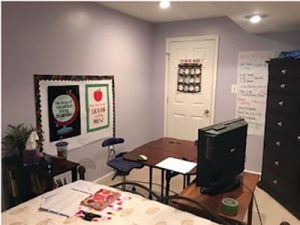
Beth Mahoney’s guest-bedroom virtual classroom.

7:47 a.m.: A teammate just texted the group and asked if we’d watched our principal’s video message. Bottom line, they’re giving us an hour of that time on Monday for real planning without any other meetings or things getting in the way! It felt really good. Every single minute helps, and it is just good to know that they took our concerns seriously. It doesn’t mean we no longer have to plan beyond contract hours, but it helps.

10:30 a.m.: Kids are finishing up their first math test. My scores (stink). This isn’t unusual for the first math test of the year, and even though I know that, it still stings. It is really hard to deliver the content through a device. I know there are things that would have helped if I’d been in person. So much is beyond my control. Silver lining: Now I KNOW who I need to support during those Monday blocks of intervention time.

5:05 p.m.: Just finished a parent conference on a FRIDAY AFTER SCHOOL! What was I thinking agreeing to that? Right, when a parent wants a conference, I make it happen. She is also a teacher, and it was great having a chance to talk with her about her son, but I had already emailed her all the information. I said it was my dad’s birthday a few times and I hoped to call him before I “passed out,” but she just kept talking. I do love connecting with parents, and we had some great conversation. I’m going to call my daddy right now.

A full Q&A with Beth Mahony

Delaney Singer

Delaney Singer ’20 teaches seventh- and eighth-grade social studies at Grifton (N.C.) School.

Mon Aug 31

Delaney Singer

6:25 a.m.: I leave for school, which is about 25-30 minutes away. During my commute, I complete my COVID screening Google form and try to prioritize the things that have to get done as soon as I enter the school building.

7:30 a.m.: I have my B Week students, whom I have not seen since the end of the first week of school. I am excited to see them but worried that because I have not seen them in so long they have fallen behind. This prediction comes true and makes the morning slightly overwhelming. My social studies classes are only 40 minutes long so there is not much time for extra unplanned agenda items.

1:30 p.m.: I have a team meeting that lasts until about the end of my planning period at 3 p.m. With all the COVID changes, there are a lot of new requirements and procedures to cover every meeting. It also does not help that this is my first year teaching so I am also trying to get used to just the normal procedures of the school. I often leave these meetings overwhelmed.

3 p.m.: I finish creating materials and activities for the next day. It is very difficult to create lessons for two subjects that have in-person and virtual students. It is not easy to create lessons that can be put online and completed at home that will also engage and challenge students.

7-10:50 p.m.: After getting home around 5:30, I took time to eat dinner, tidy the house and spend a little time with my husband. In turn, this means I have to stay up later working. When I take these very necessary breaks, I often feel guilty and regretful because I still have so much work to do. It takes a very long time to create materials for all of my classes that aren’t the same thing every day and then post them with all the necessary instructions online. I still did not finish my very lengthy to-do list, which creates stress for the next day.

tue sept 15
(Due to workload, Delaney had to put off her diary entries for a couple of weeks.)

8:30 a.m.: I had my whole day prepared, but once I looked over student work and grades, we had to change everything. A big part of being a teacher is thinking on your feet and being able to change things on the fly. But as a new teacher this still stresses me out.

wed sept 16

Noon: Getting back on track with content was fun today with my three classes of seventh graders and three classes of eighth graders. We are learning about the Renaissance in seventh grade and the 13 colonies in eighth grade. Today one lesson sparked a fun conversation on where we would live if we were colonists.

4:30 p.m.: I’m exhausted. I treated myself to a Dr Pepper from McDonald’s to get through a night of work.

Mon sept 17

11 p.m.: I’m still up trying to rework my lessons so that my students are engaged and receiving the content they need while also being able to complete everything at home. Among educators, there’s something we call “teacher tired.” Before I was a full-fledged teacher, I didn’t think much of this because I was used to being up all night studying in college. But nothing can prepare you for the “teacher tired.” It is a whole-body tired on top of emotional and mental exhaustion.

Mon sept 18

7 a.m.: The teacher tired hit me hard. I fell asleep mid-conversation with my husband last night and on arrival to school this morning attempted to use my house key to unlock my classroom door. At least it’s Friday!

Noon: My seventh graders that I just had were very excited and involved in our lesson on Renaissance art which made it so fun. They were jumping in with questions and examples throughout our time together which makes all the difference. It really makes me appreciate and enjoy what I do when my students get just as involved in a lesson as I do.

5:30 p.m.: After school, I sat with some co-workers and debriefed on the week, laughed and did work together. The time that I can have with my fellow middle school teachers just to chat and decompress is so refreshing. When you can talk to and lean on people that know exactly what you’re going through it makes life so much easier.

Administrators address educating during a pandemic

It’s not only teachers and students who have had to adjust due to COVID-19 but administrators as well. Steve Lassiter Jr. ’04 ’10, assistant superintendent for educational programs and services for Pitt County Schools, and Sonja Emerson ’09, executive director of the exceptional children program for Wayne County Public Schools, answered questions about how their districts are dealing with the coronavirus.

What’s been something unique you’ve experienced so far during this pandemic?

Lassiter: The pandemic placed us in a position where decisions have to be implemented in a matter of weeks and sometimes days. Therefore, we used our best judgment to make each and every decision — our teachers, staff, students and families were at the forefront of every decision. These decisions are not always easy.

How have the students responded?

Lassiter: Many of our students are responding well, but it is not without challenges such as maneuvering technology, accessing the internet and the lack of immediate access to their teachers. How this will impact the educational growth will be seen in the future. Right now, we are focusing on giving students a quality face-to-face and virtual learning experience.

Emerson: For our students who are very young and our students with the most significant cognitive needs, online learning and a hybrid model are very challenging for them and for their families due to their need for specially designed instruction and related service therapy.

What do you think will be some of the long-term effects of the pandemic on education and educational services?

Lassiter: Long-term, virtual education in the K-12 setting is here to stay. We have to prepare how to make it better for students and families. This means, as a system, we must begin designing how it looks in the future. It will require our curriculum department to shift our lens, in that virtual instruction does not look like in-person instruction. Therefore, curriculum specialists and instructional technology specialists must work collaboratively to support teachers in their planning.

Emerson: We have learned to adapt to how we provide instruction and therapy for our students. The laws and policies did not change with the pandemic, but how we facilitate and implement these requirements has.

What do you hope we can take away from this experience?

Lassiter: I hope the community sees the unwavering commitment and resilience of our public schools. I hope they see that teachers and district leaders are committed to ensuring that students are given the best education possible despite our circumstances. I also hope that the community has seen our school system rise to the occasion since March and support families by serving meals, delivering learning packets, providing resources to families and doing what educators, and Pirates, always do — serve.

Emerson: One of the positive changes that we have seen is that some of our students excel and do very well with virtual and online learning. Another positive change, even though it was quite challenging in the beginning, is that our teachers and instructional staff have learned new skills and methodologies for providing instruction to our students and will now have these new instructional tools to add to their toolbox for supporting all students. I honestly believe that the challenge is the same as the positive. Change is difficult for everyone, even more so for the adults versus the students. However, often with change, we are open to accepting the challenges that come with the change. We become better teachers, better instructors, better therapists and better directors.


Steve Lassiter Jr.

Sonja Emerson


Q&A with Beth Mahony

Beth Mahony ’03 said the few weeks of online teaching in the spring after COVID-19 shut down schools wasn’t enough to prepare them for designing perhaps a whole school year for distance education.

“There simply aren’t enough hours in the day,” she said. “I have to consider everything I know and understand about how children learn and work and somehow be able to make lessons that are appropriate and engaging. It just takes so much time and we’re all feeling like first-year teachers. There’s just a lot of long days and an unending to do list to get ready for the next day.

How are the students adapting to it?

It all depends on the kids themselves. Some are resilient. Others are struggling. I only know about the struggling kids because I’ll hear from their parents. When they’re online with me, they’re just so quiet, and I can’t really determine why without the parents or kids telling me privately. It hurts because I feel like there’s little I can do to help them from the classroom in my guest bedroom. Some are saying they like it because they have a lot of time to do their work. They do. The schedule was designed to make sure kids have time during the school day to work and get support so we can avoid having kids staring at devices after school hours. All day seems to be more than enough. Then there are those who are logging on, but they’re never there when called on to contribute or join a small group in a private room. Some aren’t joining other teachers for special classes, either. There isn’t evidence of connection issues, so it seems some are really taking advantage of the situation, and their parents either don’t realize it because they’re trying to work or they’re lying to their parents. That when teacher emails are surprising.

What do you think will be the short- and long-term effects of this pandemic for students and teachers/teaching?

Short-term, kids are falling behind for an academic year or two. Given everything I know about kids and learning, I know the majority of them will catch up. Kids are resilient, and when we get back to school in the buildings, they’ll bounce back. Teachers already started taking yearlong leaves of absence or are filing paperwork to retire at the earliest dates allowed.

Long-term, kids with learning disabilities or special needs will have an even greater hurdle ahead of them to catch up as much as they can with their peers. Teachers who left the field may never come back for a variety of reasons. The very real teacher shortage will only worsen and make class sizes larger. Inclement weather days may truly be a thing of the past as well. Teachers may have to face being “online ready” any time after this experience. That could prove to be very difficult in a normal year with teacher turnover and newly hired teachers. Technology continuously changing means teachers will continue to do double duty teaching and learning the tech to teach.

Are we closer to online education for younger students or has the pandemic shown we have a long way to go and might never get there or might not want to get there?

My personal views on this is that online education for our youngest learners simply isn’t appropriate. I earned my first master’s degree at ECU in 2003 in child development and family relations. The master’s in education was 2010. From what I know of child development, children learn through play, interacting with the world and other people, and experience. When I think of our kinders learning online, it hurts. I know those primary teachers are working their butts off, but even limiting the time online, there is likely too much for our 5-7-year-olds. The older kids still need the same things the younger ones need, although they should mostly be able to handle longer lessons online. In my opinion, it isn’t best practice for our young learners. However, given our situation, we are making the best of it that we can.

Back to top